

The Missing Pipe
A short history of how Britain chose the wrong heating system a century ago, and why we are unnecessarily sweating our way through a heatwave in 2026

The first rule of listening to a journalist is: under no circumstances ever take business or financial advice from a journalist. With that proviso out of the way, do you mind if I pitch you a business idea?
It all comes back to something that’s rather relevant right now, with Britain and most of Northern Europe basking/melting in an unprecedentedly hot June. Records are being broken all over the place and all of a sudden everyone is talking about air conditioning.
Why, many are asking, do we not have more air conditioning? Look at a country-by-country comparison and - to the extent that such data exists - the UK usually comes out at or near the bottom of high income nations.

The short answer of course is that, historically, Britain hasn’t had much need for AC. Compared with countries like the US and Japan we have far fewer “cooling degree days”, and hence much less demand for AC.
But there is a slightly longer and much more interesting answer, which is that this isn’t just a story about AC, and the lack thereof. It’s a story about something much deeper: about the way our homes are built (specifically the plumbing), about net zero, and the government’s heat pump strategy.
But before we get to all that, back to the explanation about why Britain still has so little AC, despite the rise in average temperatures in recent years. It mostly comes back to two things:
Decades ago we committed ourselves to heating systems that don’t lend themselves to cooling, and…
Even if you want an air conditioner today it’s surprisingly hard to find one, and nigh on impossible to find a portable one that actually works particularly well.
To take number 1 first (and I covered some of this in a Times column a few years ago) at some point about a century ago, we plumped for what are known in the trade as “wet” or hydronic systems, with boilers that heat up hot water and send it round our homes.
There are many good things to be said about wet systems: they work well in cold climates, and that hot water can be used for bathing and washing too. But most of the rest of the world doesn’t have radiators like ours. They use systems that blow air around the house, either through ducts and vents or a few wall-based units.
Air-based systems (HVAC as they’re sometimes called) aren’t perfect. The air they puff out can be stuffy and dry, though you can add filters and humidifiers if that bothers you. And you usually need a separate unit to heat your water. Even so, they have one enormously attractive advantage: connect them to a heat pump and they can both heat and cool your home.
And this is where the AC debate collides with the heat pump debate. Heat pumps, as you will probably already know, are a sort of electric alternative to a gas or oil boiler. In thermodynamic terms, they are a rather amazing technology, as you’ll see if you ponder the helpful diagram below. Whereas what a gas boiler does is to take the energy embedded in a molecule of methane and burn it, using the heat to warm the water running through your pipes, what a heat pump does is radically different.
Instead, it essentially captures the heat in the air around us and uses electricity to multiply that heat up so that it becomes warm enough to warm a radiator or a hot water tank (or to puff it out in the form of air).
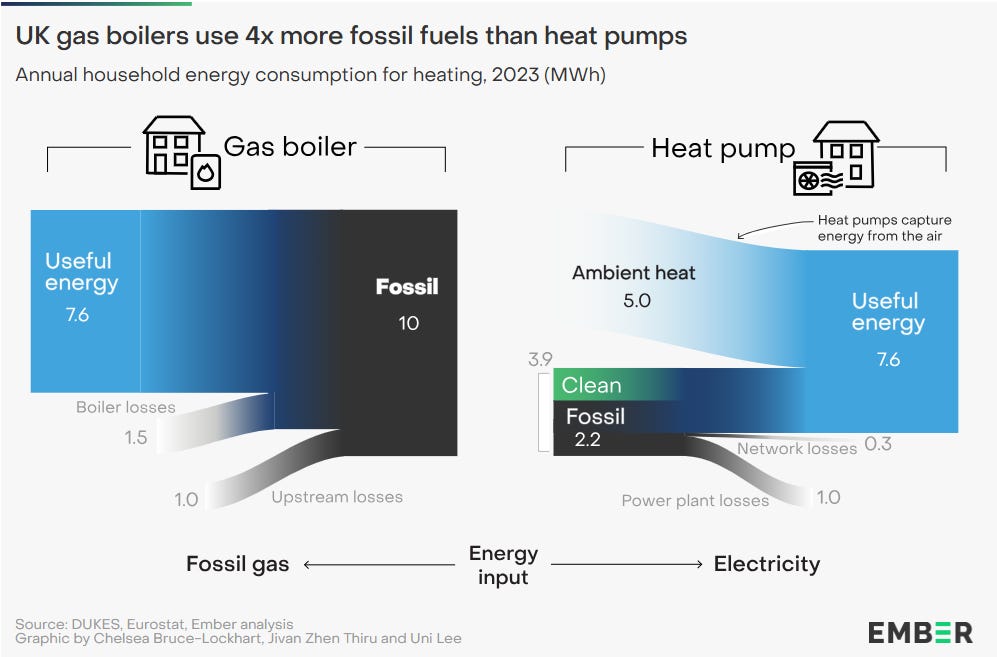
Now, there are some problems - the chief one being that heat pumps have typically not been able to get that eventual heat up to quite the same levels as a gas boiler, though the latest generation of heat pumps are a lot better on this front. But the real marvel is that - even leaving aside the net zero point which is that they are a lower carbon way of heating our homes - they are so, so much more efficient at turning the energy we put into them into the heat in our homes.
I say “heat pumps” but I’m actually oversimplifying, because in practice, there are two distinct categories of heat pumps. There are heat pumps that heat up water (air-to-water) and heat pumps that heat up air (air-to-air). The point of my column a few years ago was we were being encouraged by the government to buy air-to-water pumps, the assumption being that we should hang on to our radiators.
You can understand why they chose to prioritise “wet” systems. The last thing they want to do is tell people they need to rip out their entire plumbing system. The merit of an air-to-water system is that you simply replace your boiler and you’re away. But the problem with an air-to-water heat pump is twofold. First, it’s actually less efficient than an air-to-air system which puffs out that multiplied heat in the form of air.
Second, it’s, well, not much of an upgrade. For the actual consumer buying them, the long-and-short of it is that they would have to pay rather a lot for a system that would cost about the same to run (at current electricity prices) and results in slightly less hot radiators. Which, to my mind at least, helps explain why so many households have been so reluctant to switch. It is far easier to encourage people to spend lots of money on their home if they feel they’re actually improving their living standards.
The argument in my column was that the government should really start offering grants not just to these water-based systems but also to air-to-air pumps. All of which brings us back to this heatwave and to AC, because, you see, air-to-air pumps are, essentially, air conditioners. In the winter they provide hot air; in the summer they can blow out cold air. Really, we should be calling them “temperature pumps”, since “heat” is only half of what they do. Anyway, bafflingly (to me at least) as of a few years ago the government wasn’t offering any public support for anyone wanting to buy one.
The good news is that since that column the government has changed course and now offers some grant money for those wanting to buy an air-to-air system (I like to think the two things are connected but they almost certainly are not). The grants are far lower (£2,500 vs £7,500 for an air-to-water system) so there’s still an incentive to stick with the old “wet” radiator system. Moreover, the official advice fails to mention that if you opt for an air-to-air system you also get air conditioning thrown in for free. It’s almost as if they don’t want people to know about this amazing technology!
Anyway, once properly installed, you will end up with one big box with a fan and pump outside your house (like the picture at the top) and another unit inside the house delivering hot or cold air inside (like the one below). The whole thing will set you back a few thousand pounds but, all being well, soon enough you will save back that money in heating bills.

But for those who aren’t yet making the leap and installing a permanent system, the reality of having air conditioning in your home in the UK is decidedly unsatisfactory. Because the only way to do this is to buy a portable air conditioner.
Portable air conditioners are inherently far less efficient than the split models I described above. But for those who don’t yet want to rip up their walls and install a proper air-to-air heat pump, they are about the best thing there is for dealing with heat waves like the ones we’ve had this summer.
However, bafflingly, nearly every portable AC available for purchase in the UK today is about two or three times more ineffectual than it needs to be. There are a couple of reasons for this. The first is that they almost all use an old-school technology to cool the air. Once upon a time, the compressors inside old air conditioners/heat pumps (the bit that helps actually change the temperature) were simple on-off units. Either they were cooling at full pelt or they were doing nothing. These days, most proper heat pumps and air conditioners have what are known as inverter compressors, which can ramp up or down the cooling depending on how much is needed.
But here’s the thing: nearly all portable AC units available in the UK are based on the old on-off technology. The upshot is a) they are far more power hungry than they need to be and b) they are very, very noisy, especially when the compressor whirrs into action at full speed. For some reason, it’s very, very hard to find a portable inverter AC unit in the UK (which is not the case, for instance, in the US).1
The second problem with portable AC units is that - and I’m not making this up - they arrive without the right pipes. When you buy a portable AC in the UK, it will, almost without exception, come with a big hose at the back, which you need to stick out of a window.
That hose is an exhaust, essentially sending all the hot air outside. But strictly speaking, you really ought to have two hoses - one to send the hot out and, critically, another to suck in air from outside. The full story is to be found in this New Scientist piece but the long and short of it is that basically every portable air conditioner on the UK market today is doomed to be about two or three times less effective at cooling a room than it could be. Not because of anything wrong with the machine - literally because they don’t throw in the right plastic hoses to attach to it.
And here’s where we get to the business plan. In theory, every single one of these AC units could, through the addition of a few simple pipes and a 3D printed adaptor, be made twice as effective. Rooms could be cooled at twice the speed - for a few plastic parts that cost only 20-30 pounds. And yet, as far as I can work out, the only way you as a consumer can actually get one of these kits is to 3D print it yourself.
I can’t help but feel the market has failed on all sorts of fronts here. Millions of Britons want cooling in the summer. The demand for cooling will only grow in the coming years. But for those who don’t want a permanent air-to-air heat pump, the only options available during a heatwave, save for fans or sweating their way through it, are far, far worse than they need to be. It strikes me there’s an enormous business opportunity here.
Or maybe, well, I’m just a journalist. As I say, never take advice from folks like us. And perhaps I’ve missed something - if so, please comment below! Either way, the overarching point is that sweltering in misery during heatwaves is not an inevitability. There is technology out there to help you through it. The only problem is that it’s far harder to get hold of it than it really ought to be.
The only one I’ve encountered is the brand new Meaco Cirro (though NB you have to opt for the two more powerful models to actually get the inverter. And as far as I can make out the Cirro only has a single hose so loses out on all the efficiency gains you’d get from a double-hosed unit…
I moved to the UK nine years ago from Cayman, where AC is everywhere (for obvious reasons) and central AC is built into the designs of homes for many decades now. Water heating used to always be done by immersion heaters (typically well insulated and just left on all the time), though after we had a hurricane in 2004 that flooded the ground floor of many homes, a lot of people now have "instant" water heaters. Still electric (so not like the UK combi boilers), but work well when sized correctly.
Anyway, I was a bit shocked when I bought a "new build" home on the southern edge of London to find how hot it gets. As we all know, the UK almost mandates homes to be designed to soak up and retain heat, but in summer, that meant for me that a 26c day and 16c overnight (pretty common) gave me bedrooms that would not cool below about 27c overnight on a still evening.
So, AC was on my mind right away. My house came with (basic) solar already, so that helps a bit, but I invested £10k in total on two air-to-air heat pump solutions (good news is that all domestic AC is already able to heat as well as cool, so that makes the parts and labour zero-rated for VAT when dual use is spec'd, and that means that this is the default for AC installers in the UK already). This was before the £2500 grant, so now each system would be less.
Each system handles three rooms, so de facto the whole house is cooled. In flat out use this week (with temps yesterday at 34c and only dropping to 25c ovenight), it used only about an additional 10kwh over and above the usual daily summer electricity use.
So far so good, but what about the future?
- when my gas boiler dies (useful life around 10 years, so for me that is a couple of years away), I take it out, turn off the gas, then simply use the hot water tank already in the house. For the bathrooms in winter I remove the (hot water) heated towel rails and put in electric ones. That is all I have to do and then I am using an all electric system for heating and cooling
- I will move to an electric car soon enough and will make sure that one has bidirectional charging, so will charge up the car overnight using cheaper electricity and use it as a battery during the day.
- I may upgrade my solar panels for summer AC use, but with the car as a battery, no need for additional battery installation.
All in all, I will be off carbon-based power (gas) soon enough, and with the inexorable transition to renewables, I can see that within a reasonable time I will be heating and cooling my house efficiently (as you note) with air-to-air heat pumps, devices that will use renewable power.
Oh, and given that I am very familiar with AC compressor units outside homes and businesses in Cayman, I was astonished to find that my 10kw exterior unit runs so silently (55dba). At a distance of over about 3m from the unit, the birdsong is louder. Oh, but my neighbour has a portable AC unit running now next door, it is much louder ;)
The government grant for air-to-air heat pumps, apart from being less generous is entirely wide of the mark. You can only get it if the heat pump entirely replaces your existing heating system. Yet adding an air-to-air unit would provide both air conditioning and a more efficient form of supplementary heating than the existing heating system, allowing reductions in the gas or oil consumed in operating it. Exactly what government policy is intending, yet failing, to do. Associate an air-to-air heat pumps with solar panels to power it, and there is no added load on the grid from the aircon mode because the aircon will mostly be operating in sunny weather.