

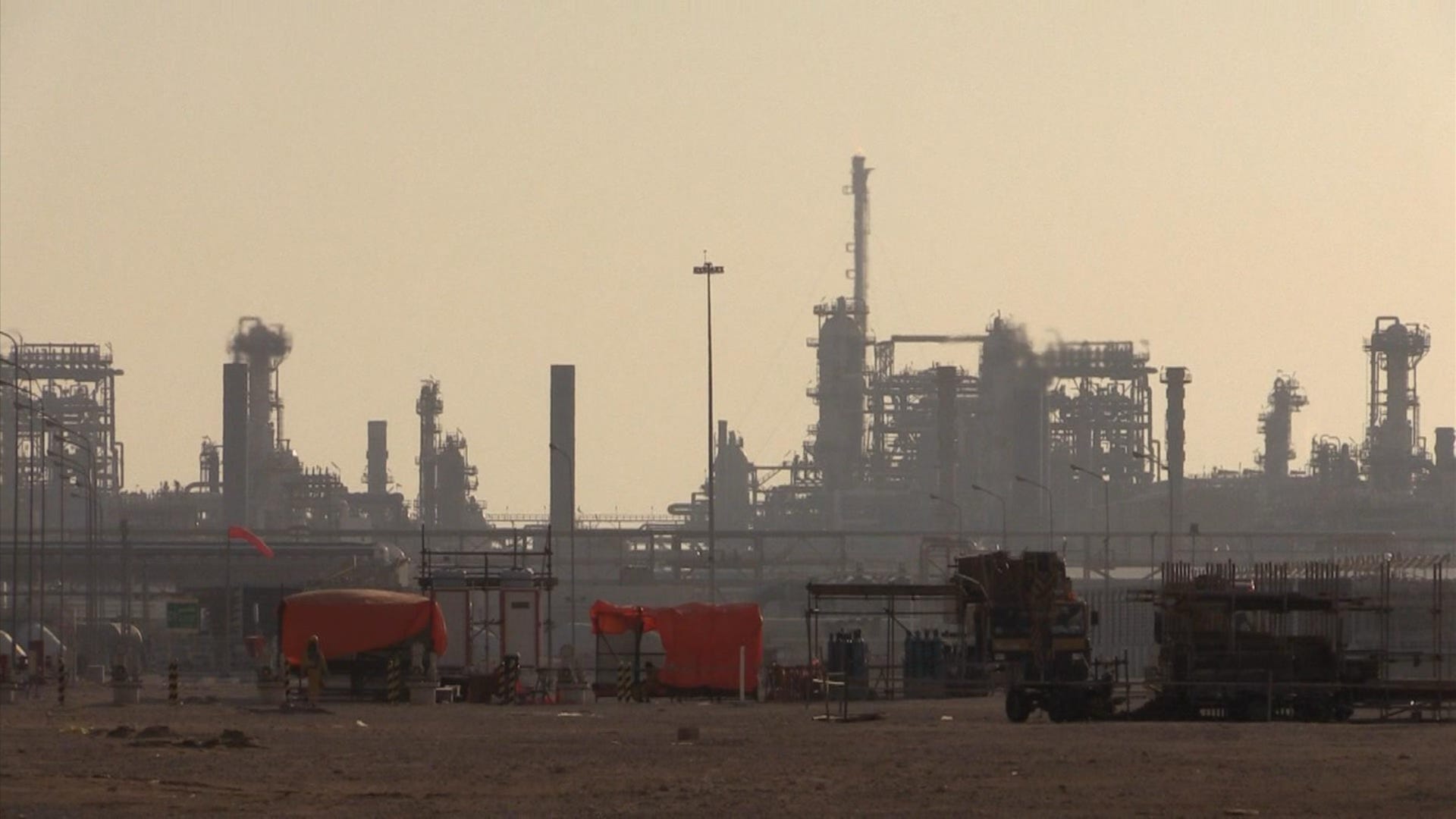
If you’ve read Material World you may recall that there was a short postscript to the section on oil. It was rooted in two places in the Persian Gulf: Ras Tanura and Ras Laffan. These two locations have similar names (“Ras” is Arabic for a headland) and might at first glance look rather similar (lots of big steel tanks and long steel pipes, as well as the occasional flaring chimney) but actually they are important in rather different ways.
Ras Tanura is the primary export terminal in Saudi Arabia, where the vast flows of oil from Ghawar and the other oil fields are processed and then loaded onto oil tankers. It is, as I described in the book, an extraordinary place - a temple to hydrocarbons, and represents a special place in the Saudi national story. For this was the place where King Abdul Aziz Ibn Saud ceremonially opened the valve in 1939 that marked the real beginning of the story of Saudi as a petrostate.
But even today, nowhere else can rival the throughput of crude that normally comes out at Ras Tanura. It gets pumped through giant pipes that serve it up to multiple enormous oil carriers, many of them loading up not at the mainland but on “Sea Island”, the offshore platform at which ships can dock and fill their bellies without ever touching dry land.
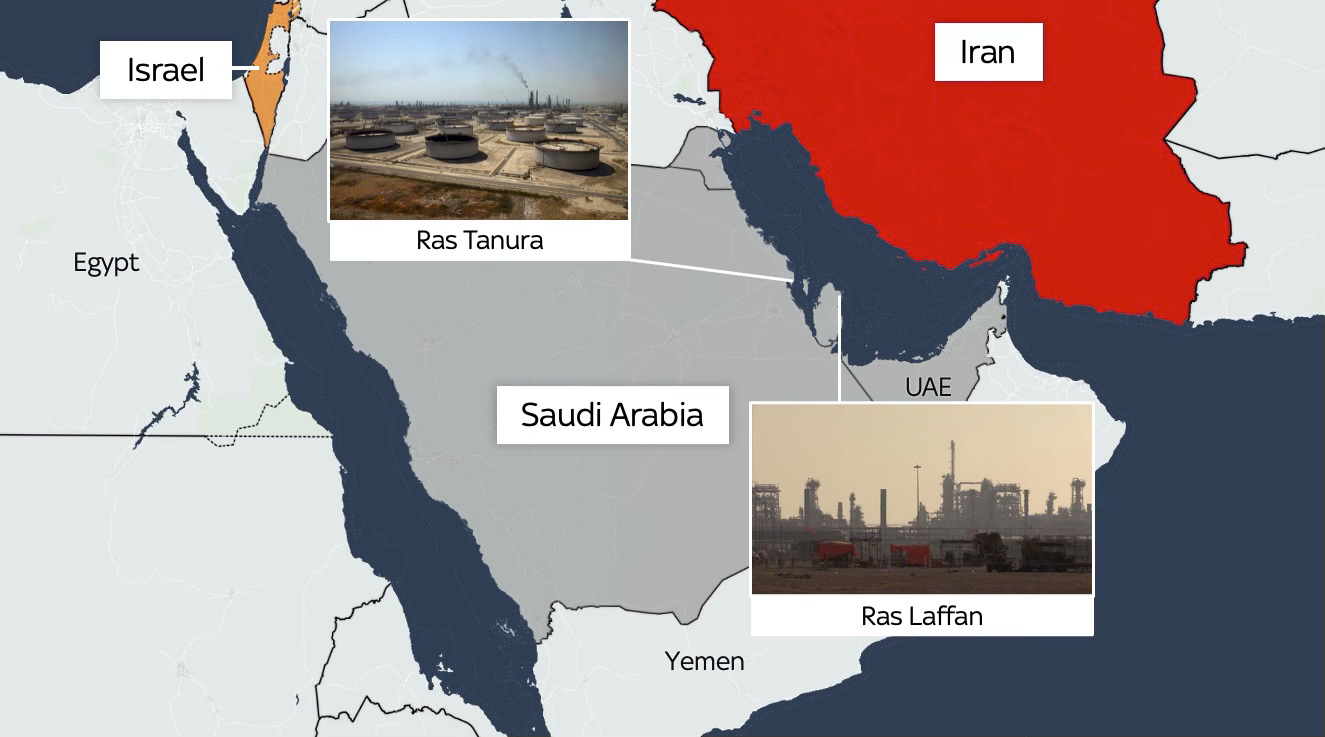
And if Ras Tanura is the ultimate central point of the global oil system, then Ras Laffan, in Qatar, is the same thing for gas, sitting as it does on the edge of the mammoth North Field (the single biggest store of useful energy anywhere on the planet). Other countries produce more gas these days than Qatar, but - and this is the crucial bit - nowhere else on the planet is quite so much oil and gas concentrated in quite such a small area.
And that, really, was the reason I wanted to write about these two places. The key point about the Persian Gulf, a point so simple it’s sometimes forgotten altogether, is that the vast majority of the gas is found in a relatively small space. Look at a map of where the oil and gas is and you very quickly see a pattern, it is mostly concentrated in and around the coastline of the Persian Gulf.
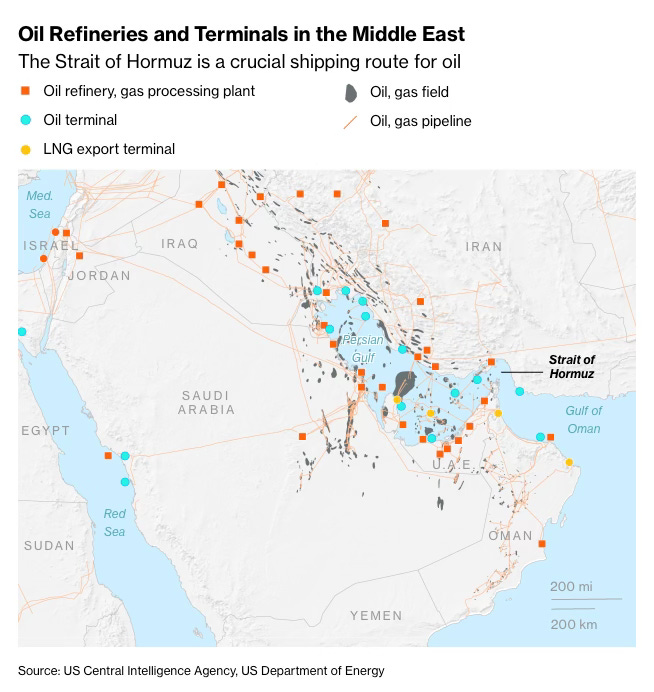
And for all that there have been a few pipelines built in Saudi Arabia and elsewhere in recent years, the infrastructure to get that oil out by land simply doesn’t exist. The vast majority of the oil has to come out by sea - hence the extraordinary amounts Qatar has been investing in liquefied natural gas plants.
And when it comes to getting that oil and gas out, there is only one way it can go: through the strait of Hormuz. Which brings us to where we are today. When I wrote this postscript in Material World, I wrote that Ras Tanura was “a very important place, and also a very vulnerable one. Directly opposite, on the other side of the Persian Gulf, is Iran, one of Saudi’s greatest enemies. This site is within range of countless Iranian missiles, which could level the port within a matter of minutes.”
Back then, it was not hard to imagine this terminal coming under attack (indeed there had been periodic drone attacks by Houthi rebels, financed by Iran, in the preceding years). What seemed less obvious was that we would, within a few years, be confronted with a closure of both of these terminals. Yet that is the extraordinary set of events that has occurred in the past week. Ras Tanura and Ras Laffan are both closed. I simply couldn’t imagine writing a sentence like that up until this week.
It is hard to know where this takes us. What we do know - and what you know, having spent time thinking about the Material World - is that politicians tend to underplay how much these places matter. They underestimate the importance of the physical foundations of the modern world. They forget about the centrality of places like Ras Tanura and Ras Laffan, until, all of a sudden, something happens that forces them to take notice. We may now be living through another one of those periods.
By definition, my day job tends to get rather busy at times like this, so I don’t expect to be able to post all that much here, but if you tune into Sky News you can catch some of the increasingly lengthy “primers” we’ve been making in an effort to wrap our heads round these baffling, terrifying global events. Here, if of interest, is the latest one.
However, it so happens I have also been working on something else, a new project that is, among other things, the explanation for why posting has been so light on this platform in recent months. I think you’ll find it interesting - it’s the most fascinating thing I’ve worked on since Material World. More on that soon. In the meantime, good luck navigating the roller coaster of geopolitics and economics over the next few weeks.
Thanks for this angle on events. It has so much more validity than the wall to wall coverage of some of the political input which becomes tedious and infuriating.
Excellent explainer. Thanks.